
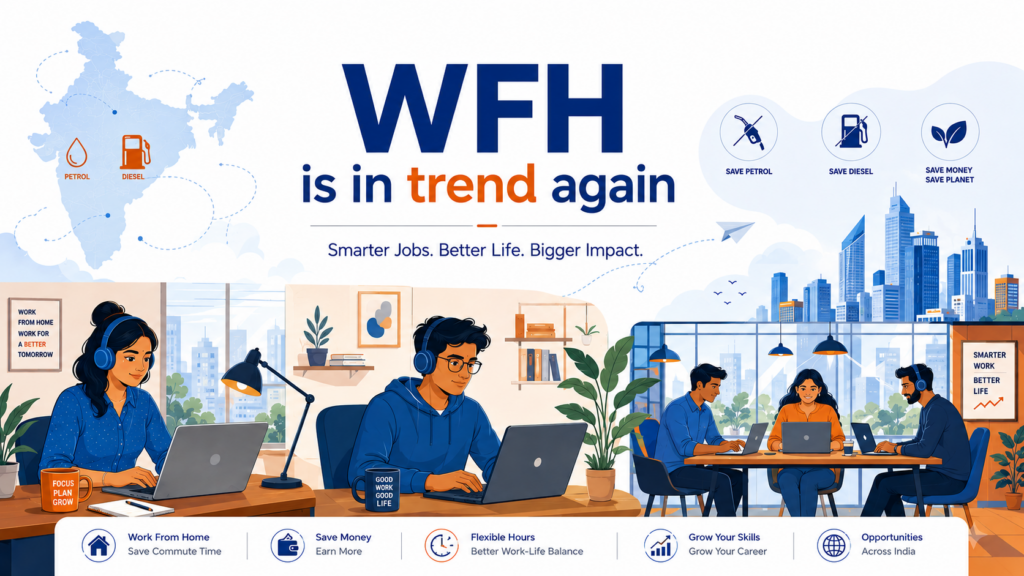
A few years ago, “work from home” felt like an emergency response. Today, it’s becoming something very different: a smarter, more sustainable way to work.
Across India, conversations around remote work and hybrid jobs are making a strong comeback after Prime Minister Narendra Modi recently urged citizens and organisations to reduce fuel consumption and conserve foreign exchange amid rising crude oil prices and ongoing tensions in West Asia. In his remarks, the Prime Minister specifically encouraged practices like work-from-home, virtual meetings, public transport, and carpooling to reduce dependence on imported fuel.
And corporate India is listening.
From large conglomerates to consulting giants, employers are once again rethinking the traditional “5 days in office” model. Companies are exploring hybrid schedules, flexible attendance, satellite offices, and remote-first roles — not just to cut costs, but to create healthier, more productive workplaces for employees.
For young professionals in Bengaluru, Gurugram, Hyderabad, Pune, Mumbai, and Chennai, this shift could redefine careers, lifestyles, and even financial freedom.
At JobinFlow, we believe this is more than a temporary trend. It’s the beginning of a more intelligent future of work.
Why WFH Is Suddenly Back in the News
The return of WFH conversations is closely linked to global economic realities.
India imports a major portion of its crude oil requirements, which means global conflicts and supply disruptions directly affect fuel prices at home. The ongoing geopolitical tensions in West Asia and concerns around oil supply routes have once again pushed fuel conservation into the national spotlight.
That is why the Prime Minister’s recent message stood out. Instead of focusing only on reducing travel or fuel usage individually, he encouraged organisations to revive digital work habits that became normal during the pandemic – including virtual meetings and remote work.
Interestingly, India Inc has responded quickly.
Reports suggest several companies have begun encouraging employees who can work remotely to continue doing so, especially for non-essential office visits. RPG Group, for example, expanded remote working and reduced travel after the government’s call for fuel conservation.
Hybrid workspaces are also seeing renewed demand. In cities like Kochi and Bengaluru, co-working hubs closer to residential neighbourhoods are gaining popularity because they reduce long daily commutes while still offering collaborative office environments.
This matters because India’s metro workforce spends enormous time commuting.
A two-hour daily commute in Bengaluru traffic is no longer unusual. Gurugram professionals often spend significant amounts every month on petrol, cabs, parking, tolls, and dining near office districts. For many young employees, the hidden cost of “going to office” has quietly become one of their biggest monthly expenses.
That is why flexible work is resonating again not only as a convenience, but as an economic necessity.
How Flexible Work Helps Employees Save Fuel, Time, and Money
For professionals in India’s major cities, remote work is not just about comfort. It is about reclaiming energy, time, and financial control.
Let’s look at a simple example.
Imagine a software engineer in Whitefield, Bengaluru, travelling 20 km each way to office, five days a week. Between petrol costs, parking, coffee runs, and occasional ride-hailing during rain or traffic, commuting alone can cost thousands of rupees every month.
Now multiply that across millions of professionals nationwide.
Even a hybrid schedule of two or three remote days per week can significantly reduce fuel usage and commuting expenses. That aligns directly with the national conversation around conserving imported fuel and reducing pressure on foreign exchange reserves.
But money is only part of the equation.
Flexible work also gives people something equally valuable: time.
Time to upskill.
Time to exercise.
Time with family.
Time to avoid burnout.
Young professionals increasingly want careers that fit into life — not careers that consume it entirely.
During the pandemic, many employees discovered they could be productive without spending hours travelling every day. And even now, employees continue to value flexibility highly. Research on post-pandemic hybrid work shows that professionals consistently prioritise work-life balance, reduced commute stress, and personal productivity when choosing flexible work arrangements.
You can also see this sentiment reflected in online communities, where many professionals discuss hybrid work expectations before accepting offers.
For Gen Z and millennial professionals, flexibility is no longer a “perk.” It is becoming a deciding factor in career choices.
How Employers Are Balancing Flexibility and Productivity
Of course, flexible work is not simply about allowing everyone to stay home forever.
Companies today are trying to find the right balance between collaboration, culture, productivity, and employee well-being.
That balance looks different for every organisation.
Some companies are adopting structured hybrid policies where employees come to office two or three times a week. Others are allowing teams to decide schedules independently. Many are redesigning offices to focus more on collaboration and less on fixed desk attendance.
PwC has continued promoting flexible and blended working approaches globally, emphasising trust-based work structures and hybrid collaboration models.
Similarly, RPG Group’s “Workplace 2.0” and hybrid-first thinking reflect a broader corporate understanding that flexibility improves employee satisfaction while still supporting business goals.
What employers have realised is simple:
Productivity does not always depend on physical presence.
In fact, many companies discovered that employees often perform better when they have flexibility over where and how they work — especially in roles involving technology, consulting, design, marketing, analytics, customer success, and digital operations.
At the same time, businesses also understand that complete isolation can hurt collaboration and team culture. That is why hybrid models are becoming the preferred middle path.
The future is unlikely to be “office-only” or “WFH-only.”
Instead, the future belongs to intelligent flexibility.
A system where employees can collaborate meaningfully when needed, while also protecting their mental health, personal lives, and productivity.
How JobinFlow Helps You Find Smarter WFH and Hybrid Careers
This changing work culture is exactly why Job in Flow exists.
Today’s job seekers are not only asking:
“What salary does this role offer?”
They are also asking:
“Will this job improve my lifestyle?”
That is where Job in Flow helps.
We are building a smarter job-matching platform designed for the modern Indian workforce — especially professionals looking for remote, hybrid, flexible, and lifestyle-friendly opportunities.
Instead of endlessly scrolling through generic job portals, candidates on Job in Flow can discover opportunities based on:
- Work-from-home availability
- Hybrid flexibility
- Preferred cities
- Skill alignment
- Industry preferences
- Work-life balance expectations
- Career growth goals
Whether you are a software developer in Pune, a digital marketer in Delhi NCR, a finance analyst in Mumbai, or a designer in Bengaluru, Job in Flow helps you discover roles that actually fit your life — not just your resume.
We believe careers should support ambition without forcing burnout.
And as India’s work culture evolves again, professionals who embrace flexibility, digital collaboration, and skill-first careers will have a major advantage.
The workplace of the future is no longer tied to one building.
It is connected by technology, driven by outcomes, and designed around people.
The Future of Work in India Is More Flexible Than Ever
The return of WFH and hybrid conversations is not just about fuel conservation or temporary economic pressures.
It reflects a much larger shift in how India wants to work.
Professionals want flexibility.
Companies want productivity.
The country wants smarter resource usage.
And for the first time, all three goals are beginning to align.
The result is a new era of work — one where careers are more adaptable, cities are less exhausting, and talent is no longer limited by daily commutes.
For young Indians building careers in a fast-changing economy, this could be one of the biggest workplace transformations of the decade.
If you’re ready to discover flexible jobs that match your skills, goals, and lifestyle, now is the perfect time to start.
Join JobinFlow and explore WFH-friendly and hybrid opportunities built for the future of work.